











|
This site is
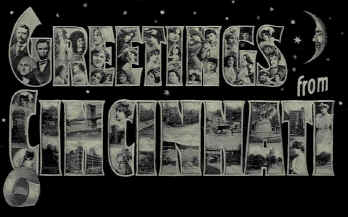
dedicated to showcasing vintage postcards of Cincinnati and the surrounding communities.
I am also adding many photographs that relate to, and increase knowledge of,
these postcards. My areas of interest consist of all communities inside the I-275 circle freeway,
plus many communities that are located just on the outside of this
corridor. In addition to Kentucky, I-275 also goes thru Indiana so you will
also see some cards from Lawrenceburg, Indiana. You will not see many cards of Northern Kentucky
here because they are already available on, what I consider, one of the best
postcard sites on the web. You will find a link at the bottom of this
page. As most of these
cards are from my own collection I am continually adding new ones so, if it has
been awhile since you looked at a section, you may want to check them out again. The ages of these cards range from
the early 1880's up to the present time. Everything is pretty basic, you click on the image to
bring up a larger view and use your back arrow to return. The postcard view is now highly sought after by many institutions and individuals, as it serves as a historical record of the past. Be it the view of a town main street, the local church, school, roadside attraction or the countryside, the postcard mirrors the way our parents, grand-parents and even ourselves, once lived. Captured in these small hand held images are views of people in the dress of the day, often at work, at play, at school or at church, offering us a nostalgic look back in time. People from the city spent their summers in the country, and others who traveled or went "visiting", all sent postcards back home. In almost every home could be found sitting on the living room table an album of these cards that were eagerly looked at whenever visitors would drop by. Even those that lived in towns and cities would send postcards to each other for in the early 1900's the postcard was the e-mail of the day. Real photo postcards, in many cases, were taken by family members to preserve the families history for future generations. In many other instances real photo postcards were taken by professional photographers showing the results of disasters occurring where they lived. They also photographed important events, festivities, parades, and anything else that they felt future generations would want to see. The very popular Kodak camera in the early days had a small door on the back that could be opened, and using a metal stylus supplied, the photographer would pull a small white strip of tape off the image they had just taken and they would than be able to write a small message stating what the picture showed. Unfortunately many people using these cameras were not informed of this capability and thus many real photos we see today are not identified. The Personal Brownie Camera allowed only one copy of an image while the Kodak 1A camera allowed 6 or 12 copies to be made. These copies could be used as "contact" negatives to make more copies but the quality of the image was reduced. After WWII large volume rotary photo processing machines made RPPC images available in the 1000s per run. There was literally nothing that could not be found on a postcard, with the possible exception of pornographic content, and I would not bet against that possibility. You have to understand that a great many cards were not stamped and mailed but were placed inside envelopes and mailed thus preserving the image from possible damage from canceling machines, it also allowed the sender to mail several cards using only one stamp. This practice also kept prying eyes from seeing what was on the card. This is why you will see postcards with messages on them but no stamp or Post Office cancellations. Every card is a glimpse into places and eras long gone, yet these images have been preserved thanks to these little pieces of paper stock. Every card you see today is because someone, somewhere felt that it was special enough to be saved as a keepsake. Up until 1952 it only cost 1 cent to send a postcard and the mail was delivered very quickly. In large cities mail was delivered 3 or more times a day! In many smaller towns, it was delivered twice a day. |



 the second icon from the right, to the left of the circular arrow has been
added. It only appears when you enter an old web site such as mine (started this
web around the mid 90s.) All I did was click on this icon and everything
instantly looked normal once again. Well it seems that things have changed
once again. I received another browser update and my icon disappeared. You
now have to go to tools, after clicking that you will find a compatibility link,
you click on that and you have to put my site on their list. Once you do that
things go back to normal (at least until the next update.) There seems to still
be a small problem that is not being corrected with the compatibility link, The
wording under many of the images are out of alignment. There is nothing I can do
to correct this problem because it looks fine on my computer but when I upload
to my web site it moves. The problem does not seem to be terribly bad and, for
now, I will have to live with it.
the second icon from the right, to the left of the circular arrow has been
added. It only appears when you enter an old web site such as mine (started this
web around the mid 90s.) All I did was click on this icon and everything
instantly looked normal once again. Well it seems that things have changed
once again. I received another browser update and my icon disappeared. You
now have to go to tools, after clicking that you will find a compatibility link,
you click on that and you have to put my site on their list. Once you do that
things go back to normal (at least until the next update.) There seems to still
be a small problem that is not being corrected with the compatibility link, The
wording under many of the images are out of alignment. There is nothing I can do
to correct this problem because it looks fine on my computer but when I upload
to my web site it moves. The problem does not seem to be terribly bad and, for
now, I will have to live with it.
HELP
Every once in awhile I get a real photo postcard that has not been identified except for some writing on the back that says Cincinnati. This ,of course, means very little as proof that it is, in fact, a Cincinnati card. Someone who is interested in selling the card can write anything they want on a card just to get rid of it. I have added a page for these cards in the hope that someone with more knowledge and information than I will be able to identify them. Any help would be greatly appreciated. A link to the page is HERE.


NORTHERN KY. VIEWS: A well laid out site with thousands of postcards and photographs. Covers many counties of Northern Kentucky.
NEWPORT POSTCARDS: Send an electronic card of some of Newport's postcards.
CINCINNATI LIBRARY: When you arrive click on the GREATER CINCINNATI MEMORY PROJECT LINK.
CINCINNATI TRANSIT: Loads of information about transportation related subjects of the area.
OHIO ONLINE SPORTSBOOKS: A detailed guide covering the best Ohio sports betting sites as reviewed by online-gambling.com.
CINCINNATI RAILROADS: Extremely well laid out site on the railroads of Cincinnati.
CINCINNATI FIRE DEPT: Very informative site containing just about anything you would want to know about Cincinnati's finest.
KY'S KENTON COUNTY LIBRARY : 7,000 images some of them postcards. Another 8,000 to be added soon with +30,000 total eventually.
LIBRARY OF CONGRESS : Thousands of photographs of Cincinnati.