These are not postcards
Shooting
Star/Wildcat
The Shooting Star
In 1947 most of The Clipper was demolished and in its place was erected the most famous Coaster at Coney, The Shooting Star. The loading station, lift hill, and the final spiral helix were saved from the Clipper. Nine hills were constructed between these ends to connect them. In 1964 the Wildcat was torn down to make room for the Skyride.
The famous Coney Island coaster Shooting Star on the last day of operation, September 6, 1971.
The Galaxi was the last coaster built at Coney in 1970 and would be dismantled and re-erected at Kings Island after the 1971 season. It was a small Italian coaster 800 feet long and reached 45 feet in height.
Six detachable postcards showing scenes that you would see when you rode the train that took you around Lake Como. Starting top left: 1-beginning journey, 2-indian raid, 3-the brave widow Stites, 4-Lytle family attacked, 5-indians attacking train, 6-journey ends.
The Lake Como Railroad was dedicated on May 1, 1964. Costing $200,000 it was one mile in length and much of it ran through the thick woods on the far end of the lake. It was the parks first "themed" attraction. Riders were warned about the deadly perils that awaited them if they dared ride the railroad. There were rampaging Indians, ferocious bears, and survivors would be very lucky to escape. 478,000 passengers rode this ride in the first season. The two trains, powered by 58-horse power engines that could puff black smoke when a button was pushed, went across Lake Como over a 462-foot wooden trestle. All the settings were animated. The trains went thru two tunnels that were also used to store them at night and during the winter.
The Jolly
Roger
The Water Ski-Ballers
The Water Ski-Ballers performed ballet numbers and high speed tricks twice every Sunday during the summer season.
The Spook was erected in 1960 and was referred to as a dark ride. In the photo above you can see the park employees beginning to install some of the rides features prior to the 1961 season. The rides four-seater cars can be seen. These cars transported the visitor thru the dark inside with a series of thrills and stunts some of which were comical. The skeleton seen in the photo was obviously part of one of the scary bits, while the cop blowing his whistle, partially seen behind the skeleton, was part of a comical scene.
The German style biergarten was constructed in 1966. It replaced the old refreshment stand located next to the games building.
In 1970 the Sid and Marty Krofft's "Circus 70" attraction was opened at a cost of $200,000. Inside was a theater specifically designed for the production of various forms of puppetry. There were fish that moved by hand puppets worn by operators wearing black suits against a black background. Pirate skeletons that were marionettes moved by strings. There were lions that were humanettes with a fabricated body for effects. There were nine puppet performers. In 1971 the show was called "Kaleidoscope" starring Krofft's Pufnstuf character.
These are not postcards
The Rotor Ride
In 1969 the parks first imported ride was installed, called the Rotor Ride. Owned by a British Company it was designed by a German, Ernest Hoffmeister. The ride consisted of a 12-foot wide revolving drum with a door in its side that allowed up to 30 people to enter. The drum then began to spin. When the speed reached around 15 miles per hour (25 revolutions per minute) the operator would push a lever and the floor would drop down. Instead of falling the patrons would stick to the side of the drum where they would stay until the floor was raised and the drum came to a stop. People who were too timid to get into the drum could watch from a section at the top. Either way it would cost them a quarter.
CLUBHOUSE & MOONLITE GARDENS
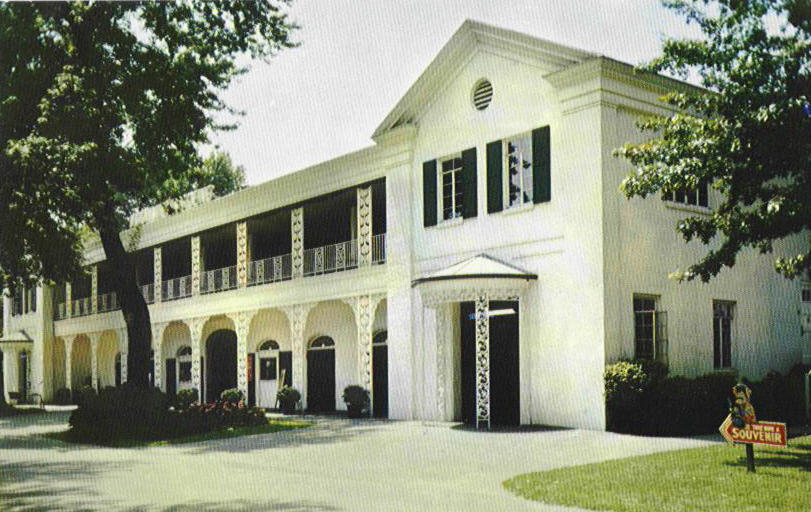
During the war years there were fewer bands available to perform and also was less dancing due to the numbers of men serving in the arm forces. For this reason dancing was discontinued in the Clubhouse in 1943 and was never reinstated. The first non-postcard image below shows the dining room of the new Clubhouse. By the mid 1950's the Clubhouse employed nearly 190 people who served everything from a 5c Ice ball to a $4.50 steak. The menu you see in the 2nd row below was good for June/ 20-21-22/1950. The inside is in 3 parts because of its size. The most popular item was the fried chicken in a basket and the chef's famous frogs legs. The most popular drinks were Coca-Cola, coffee, and beer.
In 1962 the Clubhouse was again remodeled and was renamed the "Top O' the Mall" featuring a new Continental-style outdoor dining on a balcony that overlooked the Mall. Liquors and cocktails were also served.
Top O' The Mall restaurant with Moonlite Gardens in background
In 1969 Coney spent $70,000 to, once again, remodel the old Clubhouse. It became the Velvet Palace with gay nineties decor and appropriate entertainment. Fish and chips along with family-style meals were served. This was the last life for the Clubhouse until Coney's closing in 1971.
MOONLITE GARDENS
Moonlite Gardens Extra Large Postcard
Opening in 1925 Moonlight Gardens hosted big bands for over 50 years. The Gardens you see above is the remodeled version built in 1947. All the major bands of that era played here, such as: Benny Goodman, Louis Armstrong, Glen Grey, Tommy Dorsey, Count Basie, Clyde Trask, Johnny Long, Cozy Cole, Barney Rapp's band featured a local singer you may have heard of, Doris Day. (I have counted a total of 208 bands and orchestras that played either at the ballroom, on the steamboats or at the clubhouse.) On July 25, 1953 Ralph Marterie played before a crowd of 5,564 people, and in 1964 Al Hirt set a record attendance of 6,266 people. The first performance in 1944 by two young sisters away from their home town of Maysville, KY was here, Rosemary and Betty Clooney. Many of these performances were broadcast live over the 500,000 watt local radio station WLW. In 1947 it was remodeled providing a new stage, a roof over the dance floor, and a second floor, this is the structure you see in these cards.
A large 6 3/4 X 9 3/4 card
Shooting Star--Flying Scooter
Tumble Bug
FOR MORE OF CONEY'S
LAST YEARS